Choosing a grind shapes how a blade cuts, but the steel it's made from decides how long that edge lasts, how it fails under stress, and how much upkeep it needs. This is a follow-up to the piece on knife grinds, looking at steel instead of geometry, and at how the two choices work together for bushcraft and general outdoor use.
What actually determines performance
A steel's behaviour comes down to its alloy composition (carbon, chromium, vanadium, molybdenum content) and how it's heat treated. Two knives in the "same" steel can behave differently if one is heat treated to a higher hardness than the other. With that caveat, five properties are worth tracking when comparing steels:
- Hardness – resistance to deforming under load, measured on the Rockwell C scale (HRC). Higher hardness generally supports better edge retention but tends to reduce toughness.
- Edge retention / wear resistance – how long the edge stays sharp under abrasive use. Driven mainly by hard carbides (vanadium, chromium, molybdenum) embedded in the steel matrix.
- Toughness / chip resistance – ability to absorb impact and lateral stress without chipping or cracking. Usually trades off against hardness and wear resistance.
- Ease of sharpening – how much work it takes to raise a new edge. Steels with dense, hard carbides resist the sharpening stone as much as they resist the material being cut.
- Corrosion resistance – how well the steel resists rust and staining, driven mostly by chromium content (roughly 12%+ for "stainless").
The science underneath
All of the steels here are iron with carbon dissolved in it, plus alloying elements. Heat treatment takes the steel above its transformation temperature so carbon goes into solution, then quenches it fast enough that the carbon has nowhere to go. The result is martensite: a hard, strained crystal structure that gives a blade its hardness. Tempering afterwards relieves some of that strain and trades a little hardness for toughness.
Whatever carbon does not dissolve into the matrix combines with chromium, vanadium, molybdenum, or niobium to form carbides: ceramic-hard particles suspended in the softer steel around them. Carbides are why a steel resists abrasion, and also why it fights the sharpening stone. Their size and distribution matters as much as how many there are, which is the single idea that explains most of what follows.
Why stainless resists rust
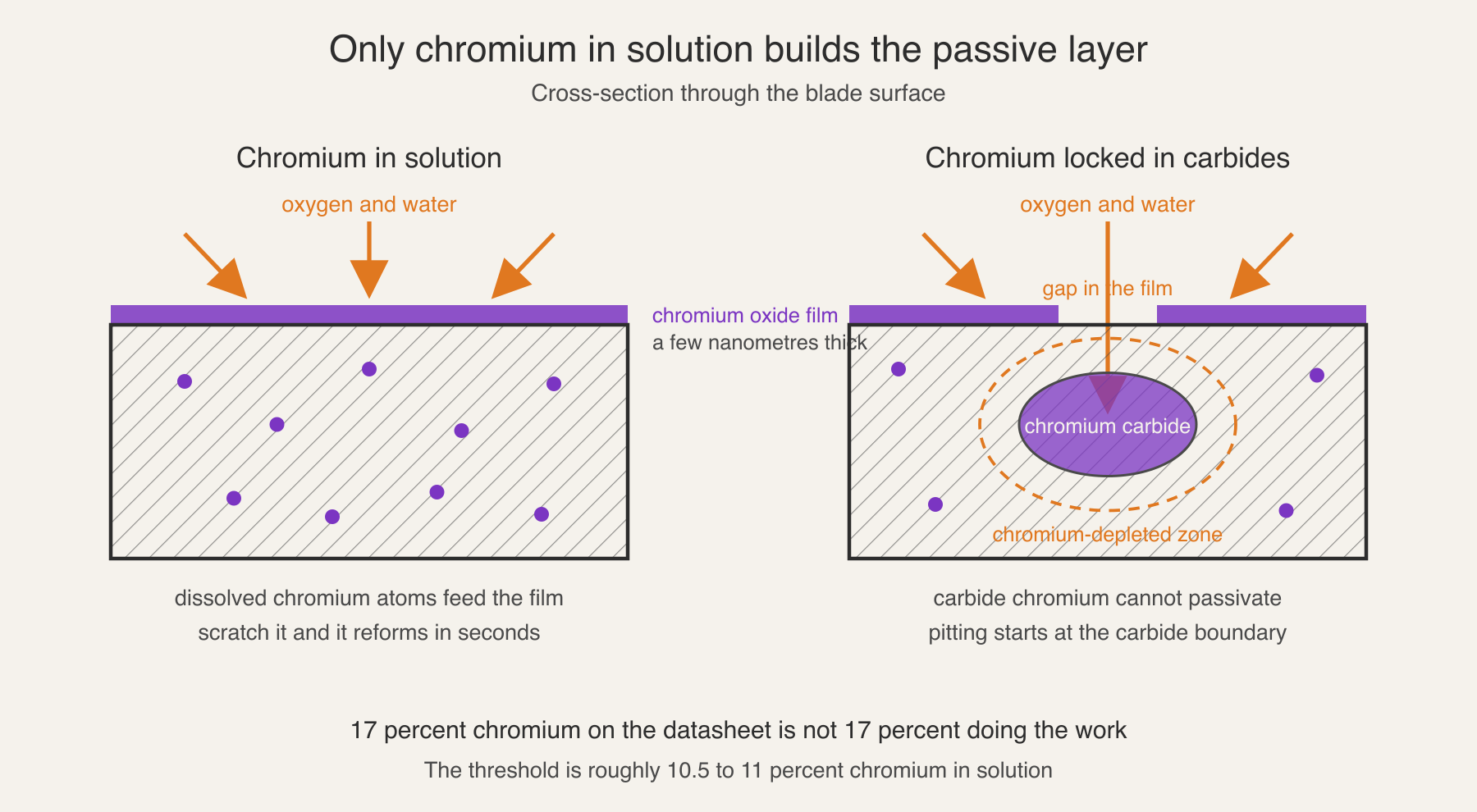
Chromium does not protect steel by being tough. It protects by oxidising first. Chromium dissolved in the steel matrix reacts with air to form a chromium-oxide film a few nanometres thick, dense and tightly bonded, and that passive layer blocks oxygen and water from reaching the iron underneath. Scratch it and it reforms almost instantly.
The threshold is around 10.5 to 11% chromium in solution, and that qualifier does the real work. Chromium locked into chromium carbides is not available to form the passive layer. A traditional stainless like 440C carries 17% chromium on the datasheet, but a large share of it is tied up in coarse chromium carbides, so the steel behaves as though it has considerably less. Worse, those carbide particles create local chemistry differences at their boundaries, which is exactly where pitting corrosion starts. High chromium on paper does not automatically mean high corrosion resistance in the hand.
Why carbon steel got its reputation for strength
Simple carbon steels like 1095 or O1 contain almost no chromium, so nearly all their carbon is either in solution or in fine iron carbides. No coarse chromium carbides means a fine, even microstructure, and a fine microstructure means toughness: the steel can absorb impact and lateral load without a crack finding an easy path through a large brittle particle.
That is the real basis for the bushcraft preference. Carbon steel takes a very keen edge because there are no large carbides to interrupt the apex, holds up to batoning without chipping, and sharpens quickly on a basic stone because there is little abrasion-resistant material to remove. It is not stronger in any absolute sense. It is tougher and finer-grained at a given hardness, which for tasks involving wood and impact matters more than raw wear resistance.
The price is rust. With no passive layer, the iron oxidises directly, and a wet knife left in a sheath overnight shows it.
Why modern carbon steels cope better with moisture
It is worth being precise here: carbon steel has not become stainless. What changed is that the gap between the two families filled in.
The middle ground is occupied by semi-stainless tool steels such as CPM CruWear and Vanadis 4E, which carry around 7.5% chromium. That is below the passivation threshold, so they will still patina and can still rust, but corrosion happens far more slowly than with 1095, while toughness stays close to carbon-steel levels. Alongside that, powder metallurgy gave even the low-alloy steels a cleaner, finer structure with fewer inclusions to act as corrosion initiation sites, and practical measures help too: a forced patina of stable black iron oxide, nitrided surfaces, and DLC or Cerakote coatings all buy real-world resistance without changing the alloy.
A modern semi-stainless blade left damp overnight will usually show a grey haze where a 1095 blade would show orange. That is the honest version of the claim.
Why modern stainless caught up on strength
Three developments closed the gap from the other direction.
Powder metallurgy. Conventional ingot steel solidifies slowly, and chromium carbides grow coarse as it does, sometimes tens of microns across. In PM production the molten alloy is gas-atomised into fine powder, each droplet freezing almost instantly, then consolidated under heat and pressure. The carbides never get the chance to grow. The same alloy with carbides an order of magnitude smaller is markedly tougher, takes a finer edge, and is easier to sharpen.
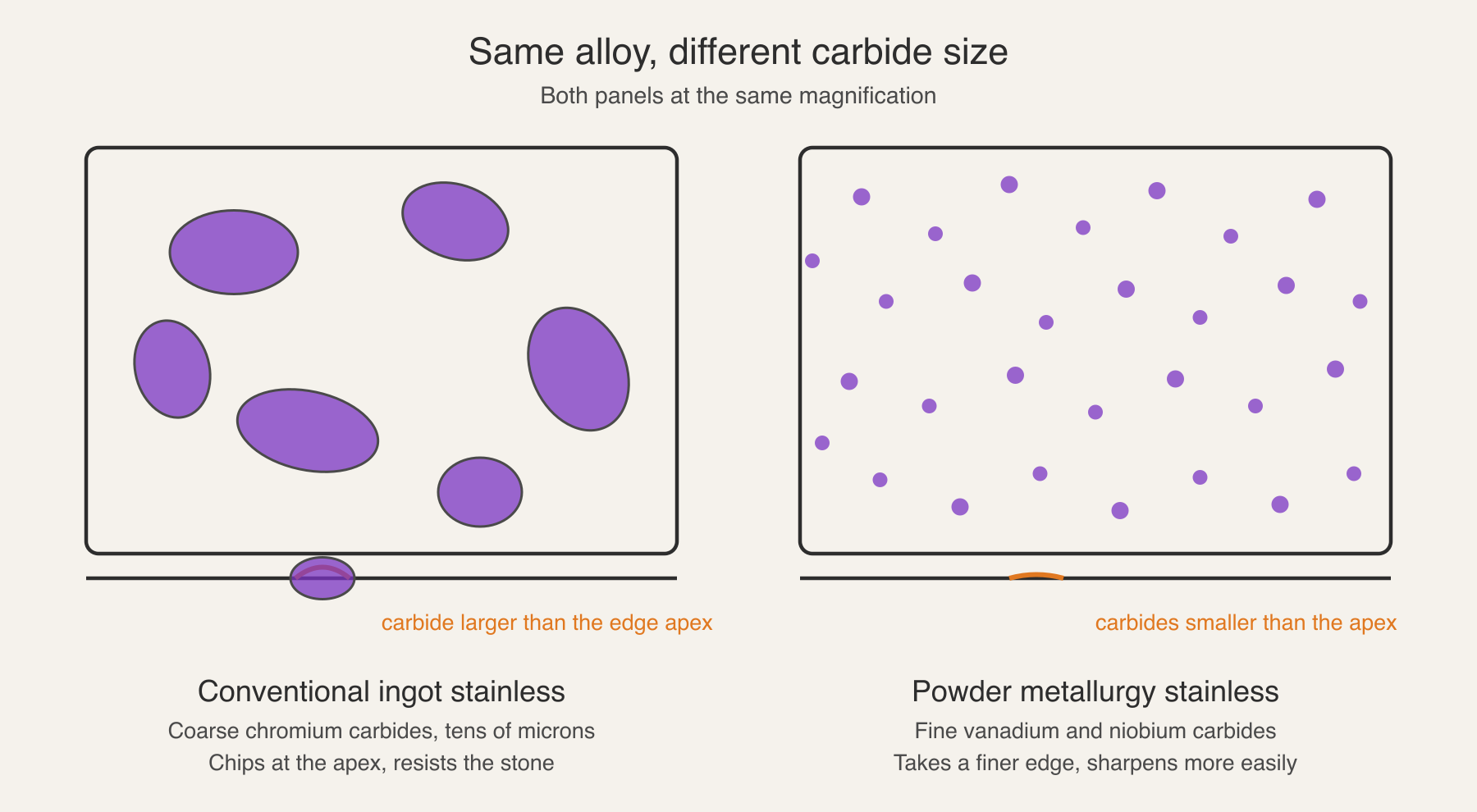
Better carbide chemistry. Vanadium and niobium carbides are harder than chromium carbides and naturally form much smaller particles. Building wear resistance from vanadium and niobium instead of chromium gives better edge retention and leaves the chromium free in solution to do corrosion work.
MagnaCut as the worked example. Larrin Thomas designed CPM MagnaCut around exactly that idea: chromium dropped to about 10.7%, carbon balanced at 1.15% so no chromium carbides form at all, with vanadium, niobium, and 0.2% nitrogen supplying the wear resistance. Every carbide in the finished steel is vanadium or niobium, every atom of chromium is in solution, and the usual pitting initiation sites simply are not there. The result behaves like a tough low-alloy steel that also happens to be properly stainless, which is why it turns up as the reference point in every comparison written since.
The old triangle of edge retention, toughness, and corrosion resistance has not been abolished. It has been pushed outward, and the trade-offs that remain are milder than they were twenty years ago.
Comparison table
| Steel | Type | Hardness (HRC) | Edge Retention | Toughness / Chip Resistance | Ease of Sharpening | Corrosion Resistance |
|---|---|---|---|---|---|---|
| 1095 | High-carbon | 56–58 | Low–Medium | High | Very Easy | Low (needs oiling/drying) |
| O1 | Carbon tool steel | 58–61 | Medium | High | Easy | Low |
| A2 | Carbon tool steel | 58–62 | Medium–High | High | Moderate | Low–Medium |
| 420HC | Budget stainless | 55–58 | Low | Medium–High | Very Easy | High |
| AUS-8 | Stainless | 57–59 | Low–Medium | Medium–High | Easy | High |
| 440C | Stainless | 56–59 | Medium | Medium | Easy | High |
| VG-10 | Stainless | 59–61 | Medium–High | Medium | Moderate | High |
| CPM S30V | Premium PM stainless | 58–61 | High | Medium–High | Moderate–Hard | High |
| CPM S35VN | Premium PM stainless | 58–61 | High | High | Moderate | High |
| CPM-154 | Premium PM stainless | 58–61 | High | High | Moderate | High |
| Elmax | Premium PM stainless | 58–62 | High | High | Moderate | Very High |
| M390 | Super steel (PM) | 60–62 | Very High | Medium–High | Hard | Very High |
| CPM S90V | Super steel (PM) | 59–64 | Very High (best-in-class) | Medium | Very Hard | High |
| CPM MagnaCut | Modern balanced PM | 60–62 | High–Very High | High | Moderate | Very High |
PM = powder metallurgy, a manufacturing process that produces a finer, more evenly distributed carbide structure than traditional ingot steel, generally improving toughness and sharpenability for a given hardness.
Notes on the standouts
Elmax (Bohler-Uddeholm) is often picked as an all-rounder among premium powder-metallurgy steels: strong wear resistance, good toughness, and excellent corrosion resistance, without being as punishing to sharpen as the very top edge-retention steels. It's a sensible choice for a folder or fixed blade that needs to handle both cutting chores and the odd knock without chipping.
CPM S90V sits at the wear-resistance extreme. Its very high vanadium carbide content gives it edge retention that outperforms most other stainless steels by a wide margin, but that same carbide density makes it slow and demanding to sharpen — diamond or CBN abrasives are close to essential — and it gives up some toughness compared to Elmax or S35VN. It rewards knives that get used hard between sharpenings (hunting, processing) rather than ones sharpened frequently by hand.
CPM MagnaCut is newer and worth flagging here even though it's not in the original list: it was designed specifically to balance toughness, corrosion resistance, and edge retention rather than maximise any single property, and it's becoming a common reference point against older "super steels" like S90V and M390.
Carbon steels (1095, O1) remain relevant for bushcraft use: lower wear resistance is offset by being genuinely easy to touch up in the field with a simple stone, at the cost of needing more corrosion care.
What the familiar brands actually use
Four brands most people already own something from, and why each choice makes sense for the knife it is in.
| Brand | Steel | Type | Hardness (HRC) | What it optimises for |
|---|---|---|---|---|
| Leatherman | 420HC | Budget stainless | ~55–58 | Corrosion resistance, easy field sharpening |
| Leatherman | 154CM | Premium stainless | ~58–61 | Edge retention on upgrade models |
| Leatherman | CPM MagnaCut | Modern PM stainless | ~60–62 | Everything at once, at flagship price |
| Opinel | Carbone XC90 | High carbon (~0.9% C) | ~55–57 | Keen edge, effortless sharpening, low cost |
| Opinel | Inox 12C27 Mod | Stainless (~0.6% C, ~13.5% Cr) | ~56–58 | Rust resistance with no upkeep |
| Victorinox | X55CrMo14 (1.4110) | Martensitic stainless | ~56 | Toughness in thin blades, easy resharpening |
| Fallkniven | Laminated VG-10 | Stainless core, 420J2 sides | 59 core | Edge retention plus lateral strength |
| Fallkniven | 3G (SGPS core, VG2 sides) | Laminated PM stainless | 62 core | Hard core, chip resistance from soft flanks |
| Fallkniven | CoS (Cobalt Special) | Laminated cobalt alloy | ~60–61 core | Fine grain, exceptional sharpening response |
| Fallkniven | Elmax | Monosteel PM stainless | 61–62 | Wear and corrosion resistance without lamination |
Leatherman runs a deliberate three-tier ladder. 420HC on the Wave+, Surge, Signal, Wingman, and Sidekick is a low-carbon stainless that no enthusiast would specify for a dedicated knife, and it is the right call here anyway: a multitool lives in a pocket or on a belt in the rain, gets used for whatever is in front of it, and gets sharpened by someone without a diamond plate. Corrosion resistance and easy sharpening beat edge retention in that job. The Skeletool CX and Charge Plus step up to 154CM for people using the blade as their main knife, and the flagship Arc and Wave Alpha carry CPM MagnaCut, which genuinely beats both on all three axes rather than trading one for another. Note that the tool components, pliers, drivers, and cutters, are a separate engineering problem: they need toughness and fatigue resistance, not edge retention, so blade steel choice tells you nothing about them.
Opinel offers the clearest carbon-versus-stainless comparison available, because you can buy the same knife either way. Carbone XC90 sits at roughly 0.9% carbon, in the same territory as 1095, and it is a superb value proposition: takes a screaming edge on any stone, sharpens in seconds, patinas within a week of cutting fruit, and rusts if you fold it away wet. The Inox version uses Sandvik 12C27 Modified at about 0.6% carbon and 13.5% chromium, a fine-grained stainless run slightly harder than the carbon version in Opinel's heat treatment. The carbon blade is nicer to sharpen and takes a finer edge; the stainless blade forgives neglect. For a knife that lives in a rucksack or gets handed to a cub, the stainless one is the sensible answer.
Victorinox uses a proprietary variant of X55CrMo14 (material number 1.4110), around 0.52% carbon, 15% chromium, and 0.5% molybdenum, hardened at 1040 °C and tempered to an average of 56 HRC. Enthusiasts sometimes dismiss it as soft, which misses the design brief. Swiss Army knife blades are thin, the knives get used as scissors, screwdrivers, and pry bars by people who will never sharpen them properly, and a harder blade in that geometry would chip rather than roll. At 56 HRC the steel is tough, essentially rustproof in normal use, and can be brought back to sharp on a kitchen steel or the bottom of a mug. It is optimised for recoverability, not retention.
Fallkniven takes a different route entirely: laminated blades, where a hard high-performance core is hot-rolled between softer stainless outer layers. The classic F1 and similar models use a VG-10 core at 59 HRC between 420J2 sides, which Fallkniven credits with roughly 20% greater lateral strength than the same blade in solid VG-10. The premium 3G version raises the core to Super Gold Powder Steel at 62 HRC flanked by VG2, and the CoS models use a cobalt-alloyed core, about 1.1% carbon, 16% chromium, 2.5% cobalt, at around 60 to 61 HRC. The principle is the same one that makes a Japanese kitchen knife work: put the hardness exactly where the cutting happens and let the softer flanks absorb bending and impact, so the blade can run a harder core than a monosteel of the same geometry would survive.
Fallkniven also sells several models in Elmax as a monosteel, notably the F1x and S1x in the X-series, hardened to 61–62 HRC, with black tungsten-carbide-coated variants alongside the bare ones. That is the tidiest illustration of the argument in this post: lamination exists to let a hard core sit behind tough flanks, and a powder stainless with fine, evenly distributed vanadium carbides is tough enough at 62 HRC that the blade no longer needs the flanks. Elmax also brings better corrosion resistance than the VG-10 core it replaces. The classic F1 is offered in an Elmax version too, so as with Opinel you can compare construction philosophies in the same knife shape.
Seen together, the pattern is that none of these brands is choosing a "better" or "worse" steel. Leatherman optimises for neglect, Opinel for sharpenability and price, Victorinox for toughness in thin stock, and Fallkniven for putting maximum hardness at the apex without giving up a robust blade. The steel follows the use case.
Pairing steel with grind
A high-wear-resistance steel like S90V on a full flat grind suits controlled, precise cutting where the edge needs to last. The same steel on a scandi grind for bushcraft carving work would be harder to maintain in the field than a tougher, easier-sharpening steel like Elmax or CPM-154 — grind and steel should be chosen together against the actual task, not independently.
Next up: a look at sharpening approaches for these different steel families, including when diamond stones or ceramic rods actually earn their keep.