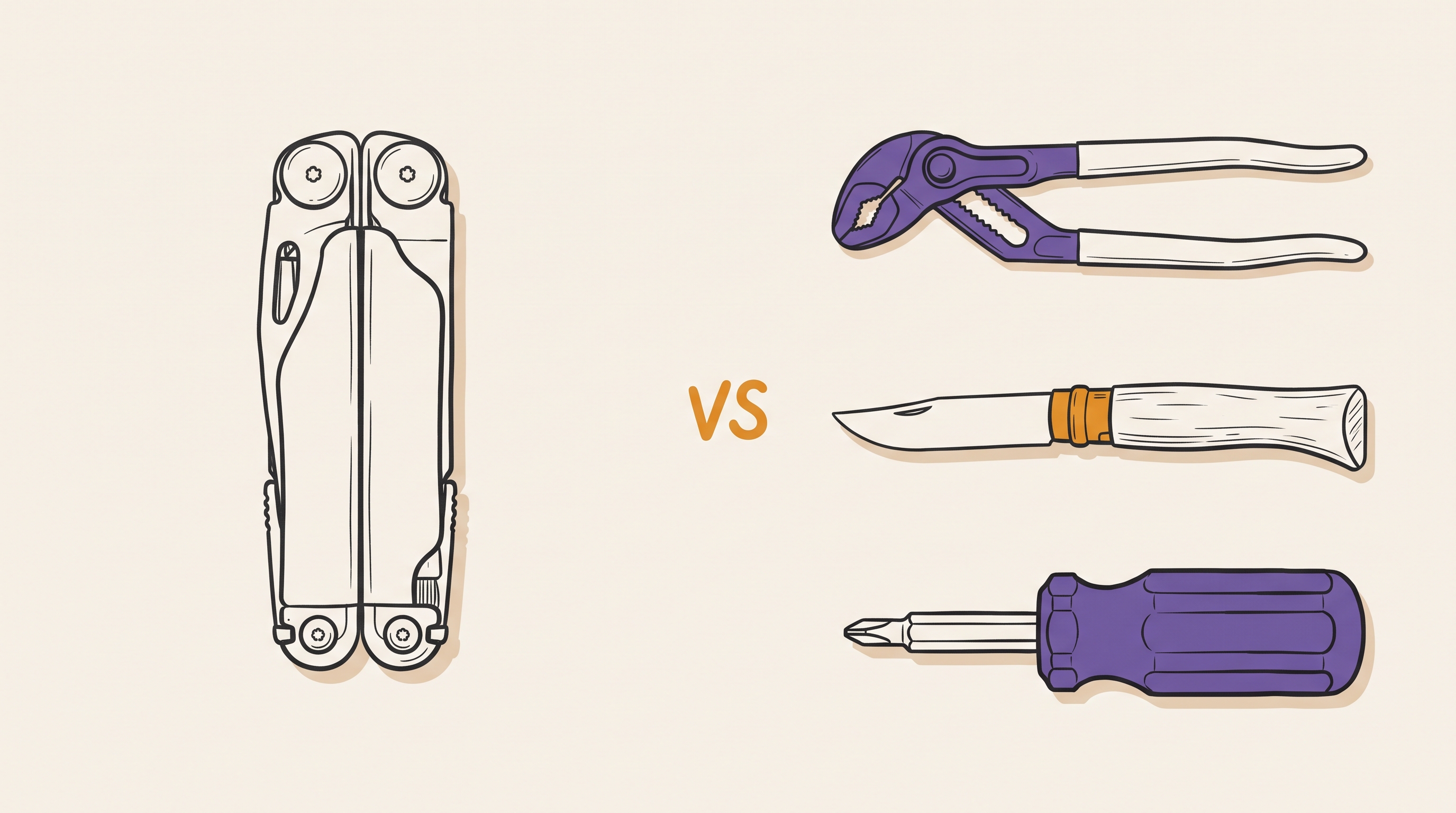
The nut on the garden tap has seized again. The Leatherman comes out of the pocket, the pliers swing open, and the jaws close on air either side of a 22 mm flat. The tool that has ridden in that pocket every day for a year cannot grip the one thing it was carried for.
This post compares a Leatherman Wave+ against three separate tools that cover the same jobs, and asks whether an uncompromised set costs more weight or more money. It is for anyone who carries a multi-tool daily and has started to wonder what the alternatives are. The comparison uses published weights and UK street prices throughout.
Where the weight sits
A multi-tool is a plier frame with implements stored in it. The Wave+ weighs 241 g, and the plier head, the two handle channels and the pivots account for most of that. Take the blades, the saw, the file and the scissors out of a Wave+ and the empty frame still weighs more than a whole Opinel.
The frame does two jobs at once. It works the pliers, and it stores and supports every other tool. Both jobs push the design in the same direction: more steel. The frame needs stiffness to transmit grip force, and it needs walls thick enough to carry a pivot pin for every folding implement.
Every implement then pays rent on that frame. The knife blade contributes perhaps 20 g of steel and carries a share of the frame that lets it fold away. Counting eighteen tools and dividing 241 g by eighteen gives a flattering number. The honest division puts most of the mass in the box rather than in the tools.
What folding costs each tool
The frame costs weight. Folding costs capability, and it costs it three separate times.
The pliers lose leverage. Handle length sets the torque a hand can apply, and the handles have to be short enough to carry in a pocket. They also have to be hollow, because the other tools live inside them. The Wave+ jaws will not reach a 22 mm nut, and plenty of fittings under a sink are larger than that.
The blade loses grind. A folding blade has to fit inside the handle channel alongside its neighbours, so its thickness and its profile are set by clearance rather than by cutting. The Wave+ blade sits in a channel it shares with a saw and a file. The result cuts, and it does not cut like a knife whose only design constraint is cutting.
The bit driver loses grip and bit choice. It folds out in line with the handle, so the closed tool is held like a stubby screwdriver. The hand closes on a flat steel channel with two square edges, not on a barrel the palm can bear down on. Torque stops at the pressure the fingers can pinch. The Wave+ takes Leatherman's own flattened bits rather than standard 1/4 inch hex, so an existing bit collection needs the Bit Driver Extender accessory before it fits. The tool carries one reversible bit, which is two tips.
The three-part kit
Three tools cover the same three jobs, and none of them shares a handle. The Opinel folds, but its handle carries one blade and nothing else. Each tool is built around its own job, with nothing given up to storing the others: solid handles, a blade shaped only for cutting, a barrel the palm can bear down on. An uncompromised set costs either weight or money, or it costs neither.
Knipex Cobra XS
The Cobra XS weighs 62 g and measures 100 x 30 x 10 mm. It costs about £25. The jaws take pipes to 28 mm diameter and nuts to 24 mm across the flats, which is larger than the Wave+ manages with handles 65 mm longer.
Water pump pliers achieve that range by moving the pivot rather than opening the jaws. A push button steps the pivot along a slotted track, so the handles stay at a comfortable angle whatever the jaw opening. The jaws self-lock under load, which means grip force comes from the workpiece pushing back rather than from the hand squeezing harder.
The handles are solid, because nothing lives inside them. A solid 100 mm handle is stronger than a hollow 165 mm one, and it grips larger nuts.
Opinel No 08
The Opinel No 08 in carbon steel weighs 45 g and costs about £12. The blade is 8.5 cm, the handle is beech, and the Virobloc collar locks the blade open and closed.
Nothing about the blade is set by clearance. It is thin behind the edge because a thin edge cuts, and the taper runs the full height of the blade rather than stopping at a shoulder. XC90 carbon sharpens on almost anything and takes an edge in a couple of minutes on a stone.
The handle matters as much as the steel. A wooden handle fills the palm, warms to the hand and gives a grip that does not depend on finger pressure. The alternative is holding two hollow steel channels edge-on while cutting.
PB Swiss 6460 Insider
The PB Swiss 6460 Insider weighs 89 g including eight 1/4 inch C6 bits stored in the handle. It costs about £56, and it is the expensive part of the kit.
The handle is the point. It is a round screwdriver handle the palm can bear down on, so grip force does not stop at what the fingers can pinch. The bit magazine slides out of the tail and locks, so the bits travel inside the tool rather than in a separate pouch. The bits are standard 1/4 inch C6, so hex, Phillips and Pozidriv come out of any bit set already in the drawer.
There is no ratchet. That is a deliberate choice and not only a weight saving. A ratchet adds a pawl, a spring and a direction lever, and each is a part that can fail under load in a pocket-carried tool. A fixed driver has nothing to strip.
The numbers
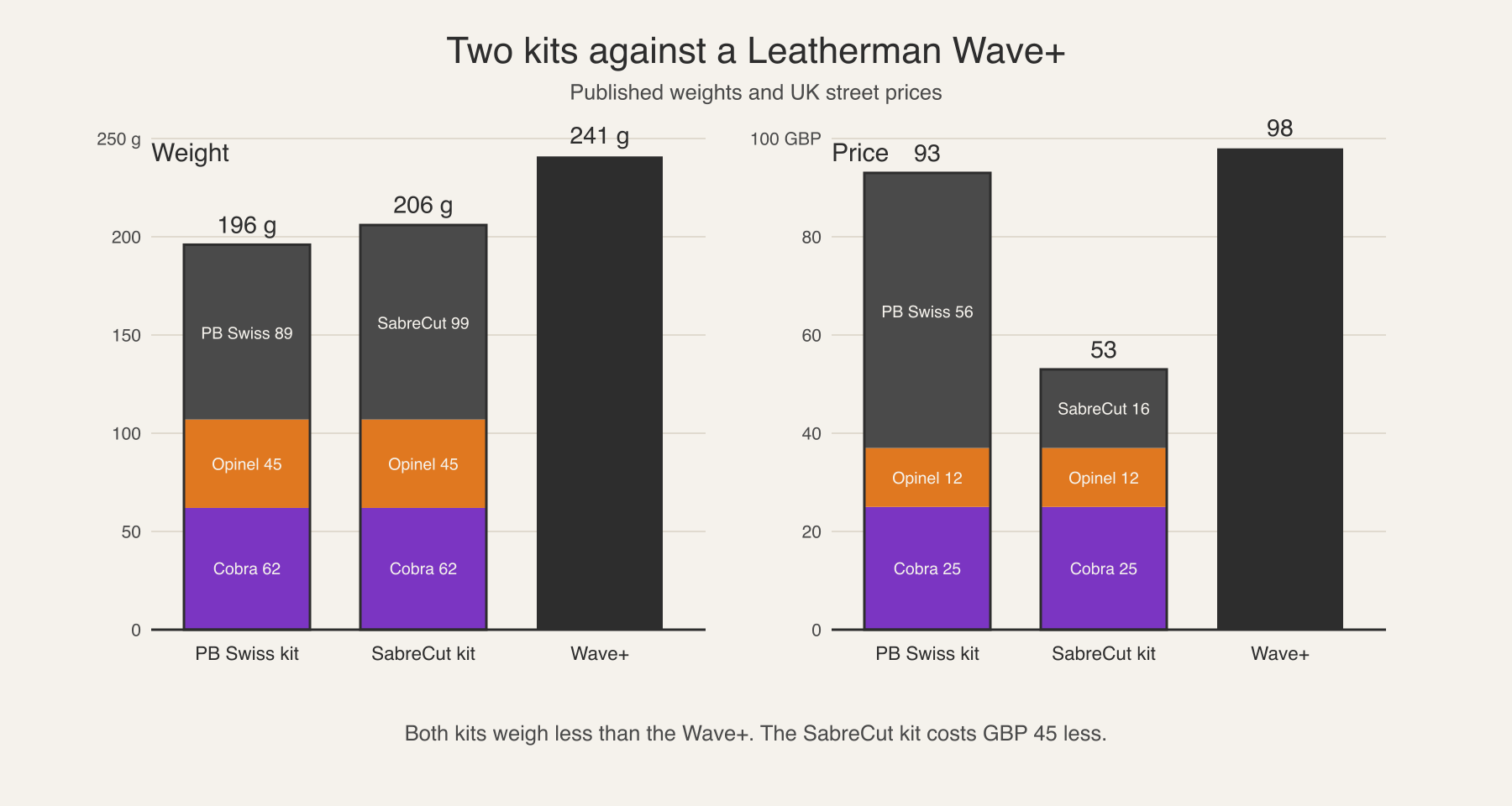
The weights land close together. The prices do not, because the driver sets them apart.
| Item | Weight | Price |
|---|---|---|
| Knipex Cobra XS 87 00 100 | 62 g | £25 |
| Opinel No 08 carbon | 45 g | £12 |
| PB Swiss 6460 Insider, 8 bits | 89 g | £56 |
| Kit total | 196 g | £93 |
| SabreCut MRSC01K1, 4 pieces | 99 g | £16 |
| Kit total with the SabreCut | 206 g | £53 |
| Leatherman Wave+ | 241 g | £98 |
The first kit saves 45 g and £5. Neither number matters on its own. A 19% weight saving is inside the noise of whatever else is in the pocket, and £5 on a hundred is a rounding error.
For 45 g and £5 less, the kit grips a 24 mm nut, cuts with a knife-shaped knife and drives a screw with a handle the palm can push. The weight of a multi-tool does not buy capability. It buys the convenience of one object, and the capability pays for it.
A cheaper driver
The PB Swiss is 60% of the kit price. Pliers and knife together come to £37, and the driver alone comes to £56.
The SabreCut MRSC01K1 covers the same job for £15.99. The kit holds a stainless ratchet of 58 g and 85 mm, a 60 mm magnetic bit holder, PH2 and PZ2 impact bits and a pouch, and the four pieces together weigh 99 g. The gear is chrome-molybdenum with 72 teeth, rated to 52 Nm. The body drives in line with the screw or turns across it as a ratchet.
Swapping it in brings the kit to 206 g and £53, so the second kit costs 10 g more and £40 less. It also changes the driver in two ways that pull in opposite directions. It gains a ratchet, which turns a screw in a recess too tight for a full swing. It loses the handle, because 85 mm of stainless steel is a body the fingers turn rather than a barrel the palm bears down on. Hex bits are not in the box and add about 3.5 g each.
Neither kit is the right answer for everyone. The PB Swiss kit is the lighter one and drives the stiffest screws. The SabreCut kit comes in at £45 under the Wave+, a little over half the price, and reaches into places neither of the others will.
The lighter Leatherman
The Wave+ is not the lightest Leatherman that covers these three jobs. The Skeletool carries pliers, one combination blade and a bit driver, and little else. It weighs 142 g, measures 100 mm closed, and costs about £76.
That undercuts both kits. The PB Swiss kit gives away 54 g to it and the SabreCut kit gives away 64 g. Anyone choosing on weight alone should buy the Skeletool.
The three compromises survive the diet. The jaws are needle-nose and narrower than the ones on the Wave+, so they reach nothing like 24 mm. The blade still folds into a handle channel. The driver still takes Leatherman's flattened bits, and the tool carries two double-ended bits, so four tips in total.
The Skeletool wins on weight and the kit keeps the capability. Price runs the other way again, since the SabreCut kit at £53 lands £23 under it.
What you give up
The kit loses four tools outright. There is no saw, no file, no scissors and no awl. Anyone who uses the Wave+ scissors weekly keeps the Wave+.
It also costs pocket space in a way the total weight hides. Three objects need three places, or a pouch, and a pouch is another thing to carry. Three objects are three things to lose, and the Opinel is the one that walks off.
Deployment splits two ways. The Wave+ carries its blades on the outside, so a blade opens one-handed, and the Opinel needs two hands and a twist of the collar. The pliers go the other way, because the Wave+ handles have to swing apart before the jaws are usable, and the Cobra XS is already a pair of pliers. The kit also costs a moment of reaching for the right pocket.
When the Wave+ still wins
Unpredictable work favours the multi-tool. A day when the next job is unknown is a day for carrying eighteen adequate tools rather than three good ones.
Belt carry favours it too. One sheath on a belt is comfortable, and three pouches are not. Anyone who works from a belt rather than a pocket is already carrying the frame for free.
Lending favours it. Handing a colleague a Wave+ solves whatever they have. Handing them one third of a kit solves a third of it.
Closing
Weigh and price whatever is in the pocket now. Then count the tools actually used in the last month, not the tools on the packaging.
If that list is pliers, knife and screwdriver, the frame holding the other fifteen costs 45 g and £5 against the PB Swiss kit, and 35 g and £45 against the SabreCut kit. If the list has scissors on it, keep the Wave+.