A torch beam sweeps across a low branch in the dark and stops. A single thread of spider's web shines back, one that nobody saw at four o'clock in daylight. Every child in the group leans in to look at it.
This post describes a 14-item hunt that produces that moment on an autumn evening. It is written for Scout and Cub leaders, and for parents who run an activity for a group. It includes a printable sheet with sketches, an example message to parents, and a risk assessment to adapt.
Download the printable sheet: Woodland scavenger hunt (PDF)
The checklist
Each item asks the group to find, compare or listen for something. None asks for a name, so a leader who cannot tell beech from birch can still run it.
| Done | Find or hear | What to look for |
|---|---|---|
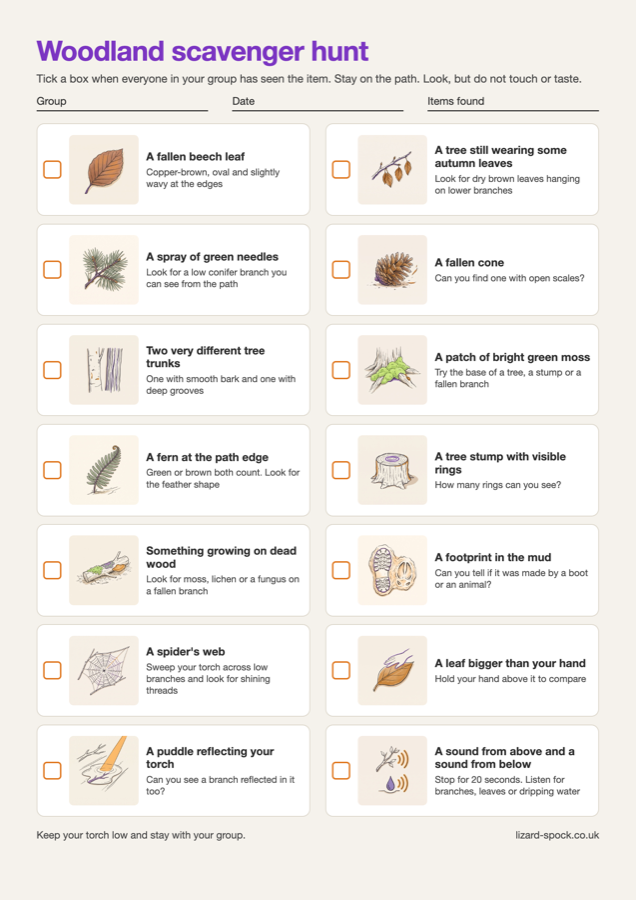
| ☐ | A fallen beech leaf | Copper-brown, oval and slightly wavy at the edges |
| ☐ | A tree still wearing some autumn leaves | Look for dry brown leaves hanging on lower branches |
| ☐ | A spray of green needles | Look for a low conifer branch you can see from the path |
| ☐ | A fallen cone | Can you find one with open scales? |
| ☐ | Two very different tree trunks | One with smooth bark and one with deep grooves |
| ☐ | A patch of bright green moss | Try the base of a tree, a stump or a fallen branch |
| ☐ | A fern at the path edge | Green or brown both count. Look for the feather shape |
| ☐ | A tree stump with visible rings | How many rings can you see? |
| ☐ | Something growing on dead wood | Look for moss, lichen or a fungus on a fallen branch |
| ☐ | A footprint in the mud | Can you tell if it was made by a boot or an animal? |
| ☐ | A spider's web | Sweep your torch across low branches and look for shining threads |
| ☐ | A leaf bigger than your hand | Hold your hand above it to compare |
| ☐ | A puddle reflecting your torch | Can you see a branch reflected in it too? |
| ☐ | A sound from above and a sound from below | Stop for 20 seconds. Listen for branches, leaves or dripping water |
Every item sits within sight of the path, so the group never needs to leave it. The printable sheet carries the same 14 items with a sketch beside each one.
Running the hunt
Split the group into pairs or sixes, with one adult for each small group and one torch for each child. Give each group a copy of the sheet and a pencil. Agree a time limit of 40 to 50 minutes and a turn-around point before anyone starts walking.
Tick an item only when every member of the group has seen it. That rule slows the walk down and keeps the group together.
The sound item needs a stop. Everyone stands still, switches off torches if the light allows, and listens for 20 seconds. A short count in the group works better than a leader's instruction to be quiet.
Finish back at the meeting point with a headcount and a short round-up. Ask each group which item took longest to find and which one surprised them.
What each item teaches
The items fall into four skills, and a leader can use them to pick a badge requirement or a discussion question.
- Shape and structure: the beech leaf, the big leaf, the needles, the cone, the fern and the two trunks. The group compares edges, size, scales and bark texture.
- Close looking: the moss, the growth on dead wood, the stump rings and the web. These need a torch held low and a slow approach.
- Reading signs: the footprint and the autumn tree. The group infers who passed and what the tree is doing, with no name needed.
- Light and sound: the puddle and the two sounds. Torch light behaves differently on water, and the dark makes small noises easy to hear.
Leaders often assume that a nature hunt needs a plant identification guide. This one does not. Counting rings, comparing a leaf with a hand and listening for 20 seconds all train the same habit of slow, close attention.
Adapting it
- Daylight: swap the web, puddle and torch items for a bird, a pine cone and a different leaf shape.
- Spring: replace the cone and the autumn tree with a bud, a catkin or a flower at the path edge.
- Beavers: cut the list to eight items and run it in one group with every adult beside a child.
- Scouts: add a naming task. Ask the group to identify two of the trees from bark and twig alone.
Information for parents
A message to parents works best when it answers four questions: where, when, what to bring and who to contact. This is the message we sent for the Binning Wood hunt, in East Lothian.
Meeting at the larger car park at Binning Wood for a scavenger hunt.
Map: https://maps.app.goo.gl/HP5R1eRnHkpPjWQX7
what3words:
///blanked.countries.rates(https://w3w.co/blanked.countries.rates)Please remember a fully charged torch, warm clothes, a waterproof jacket and suitable footwear.
A what3words address pins the exact spot of a car park with no street number. Add the start time, the finish time and a contact number for the evening before you send the message.
Risk assessment
This table is an example for a group walk on woodland paths in the dark. Review the site before the evening, adapt every row to your group, and follow your own association's guidance on ratios and consent forms.
| Hazard | Who is at risk | Controls | Risk after controls |
|---|---|---|---|
| Trips and slips on roots, mud and wet leaves | Everyone | Stay on the path. Wear suitable footwear. Walk, never run. Check the route in daylight. | Low |
| Darkness and poor visibility | Everyone | Every child carries a charged torch. Adults carry a spare. Keep groups small and within sight of an adult. | Low |
| A child separated from the group | Children | Tick the item only when the whole group has seen it. Name the turn-around point. Count heads at every stop and at the finish. | Low |
| Cold, wet weather | Everyone | Tell parents the kit list in advance. Carry a spare waterproof and a hot drink. Shorten the walk if conditions worsen. | Low |
| Vehicles in the car park | Children | Meet and finish away from moving cars. Hand children over to parents on foot, in the car park, with an adult present. | Medium |
| Falling branches in high wind | Everyone | Check the forecast. Cancel or move the activity if gusts are strong. Stay away from dead or damaged trees. | Low |
| Contact with fungi, plants or animal droppings | Children | Look but do not touch or taste. Wash hands before any food. Tell children to report anything they pick up. | Low |
| Ticks | Everyone | Cover legs and arms. Check for ticks after the walk and tell parents what to look for. | Low |
| Other path users, such as cyclists and dog walkers | Everyone | Keep the group to one side of the path. Use torches to be seen. Brief children to stop and let others pass. | Low |
| Medical needs and allergies | Individuals | Collect medical details before the evening. Carry a first aid kit and any child's inhaler or medication. Keep a charged phone and know the nearest road access. | Low |
Add a line for the leader-to-child ratio and for the named person who holds the emergency contact list. Sign and date the assessment and keep a copy with the register.