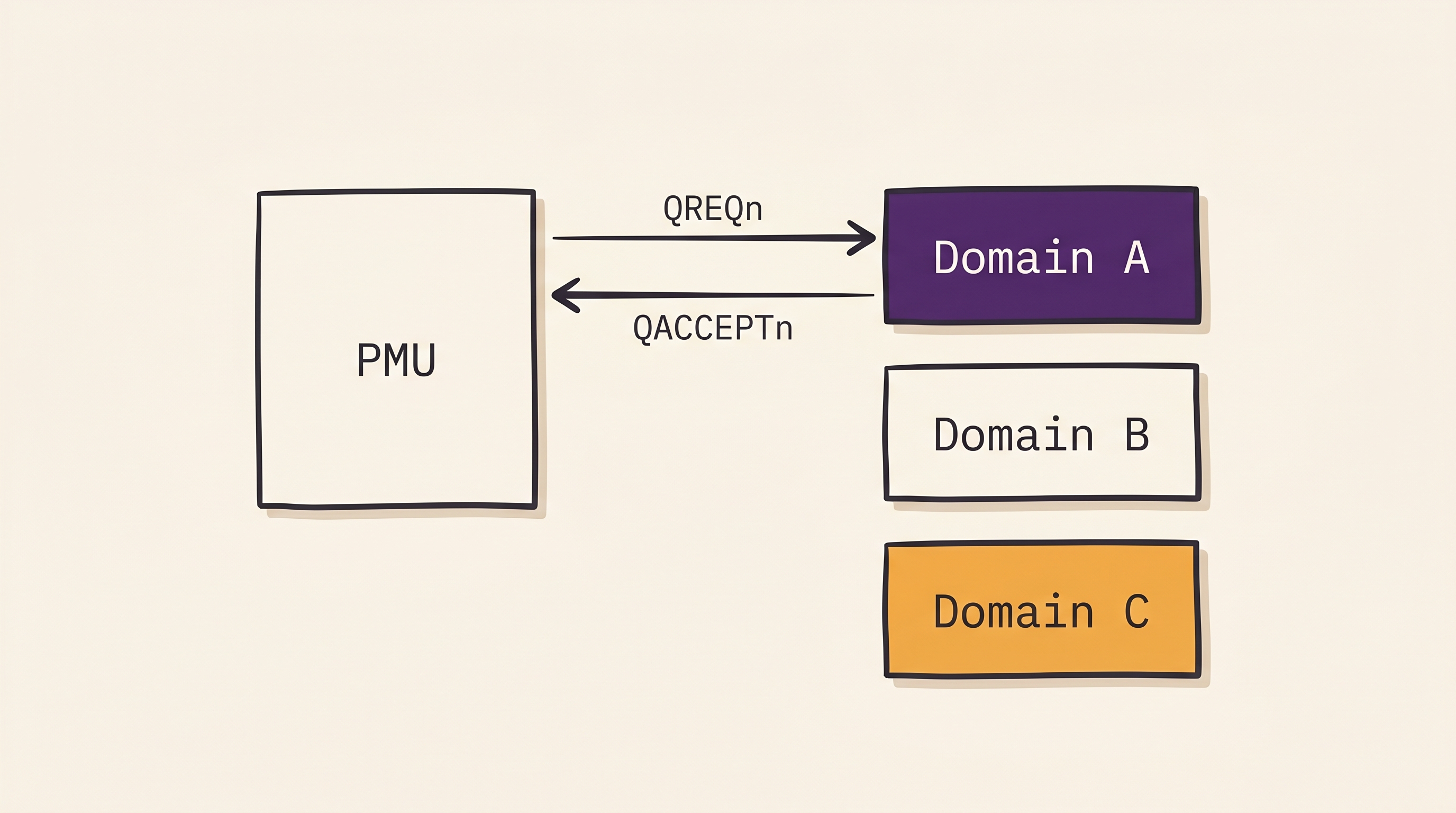
Modern System on Chip (SoC) designs contain dozens of independent IP blocks, each drawing power even when inactive. The AMBA (Advanced Microcontroller Bus Architecture) Low Power Interface (LPI) provides every block with a standardized handshake protocol to coordinate safe clock and power removal. This post covers both LPI interface types, Q-Channel and P-Channel, with timing diagrams and state machines drawn from the ARM IHI0068 specification.
Why low-power handshaking matters
Every IP block on a System on Chip (SoC) draws power even when it sits idle. Clock gating and power gating are the primary tools for reducing that static power drain. Clock gating stops the clock to a block without removing its power rail. Power gating removes the power rail entirely for deeper power savings. Both techniques corrupt internal state if the controller applies them while the block has outstanding transactions or unflushed pipelines. A handshake protocol requires the block to signal that it has finished all activity before the controller removes its clock or power. Without this handshake, the controller has no reliable way to determine whether gating is safe.
Signal naming conventions
AMBA (Advanced Microcontroller Bus Architecture) LPI (Low Power Interface) uses a consistent naming scheme across all its interfaces. Understanding this scheme makes signal tables and timing diagrams much easier to read.
Active-level suffixes
Signals with an n suffix are active low: the signal is asserted when driven to logic 0. QREQn (quiescence request) is active when its value is 0, meaning the controller is requesting quiescence. Driving it to 1 deasserts the request. Signals without an n suffix are active high: QDENY is asserted when its value is 1, meaning the device is denying the request.
Width notation
Multi-bit signals carry a width specifier in brackets. PSTATE[M-1:0] is M bits wide, where M is implementation defined. PACTIVE[N-1:0] is N bits wide, with one bit per monitored power domain. Single-bit signals carry no width notation.
Parity check suffix
Issue D of IHI0068 introduced optional parity protection. Each primary signal gains a companion check signal with the CHK suffix. QREQn pairs with QREQCHK, and QACCEPTn pairs with QACCEPTCHK. Each check signal carries the odd parity of its primary signal, so the XOR of a signal and its check signal is always 1 when no fault is present.
Q-Channel: the quiescence handshake
Q-Channel (Quiescence Channel) handles the most common low-power scenario: safely stopping a device so the controller can gate its clock or power. It evolved from the AXI Low Power Interface signals CSYSREQ, CSYSACK, and CACTIVE, and remains backward compatible with AXI LPI devices when QDENY is absent.
Q-Channel signals
Q-Channel uses four signals. The controller drives QREQn; the device drives the remaining three.
| Signal | Direction | Active level | Description | Introduced |
|---|---|---|---|---|
QREQn |
Controller to device | LOW | Requests the device to quiesce | IHI0068 B |
QACCEPTn |
Device to controller | LOW | Device has quiesced; clock or power gating is safe | IHI0068 B |
QDENY |
Device to controller | HIGH | Device cannot quiesce at this time | IHI0068 B |
QACTIVE |
Device to controller | HIGH | Device has pending activity | IHI0068 B |
The specification requires QREQn to be register-driven at the controller. QACCEPTn and QDENY must be register-driven at the device. QACTIVE can be a combinational OR of internal activity signals.
Q-Channel state machine
The Q-Channel defines 6 legal states. The values of QREQn, QACCEPTn, and QDENY determine the current state entirely. Two paths exist: an accepted path where the device quiesces, and a denied path where the device refuses and the controller withdraws.
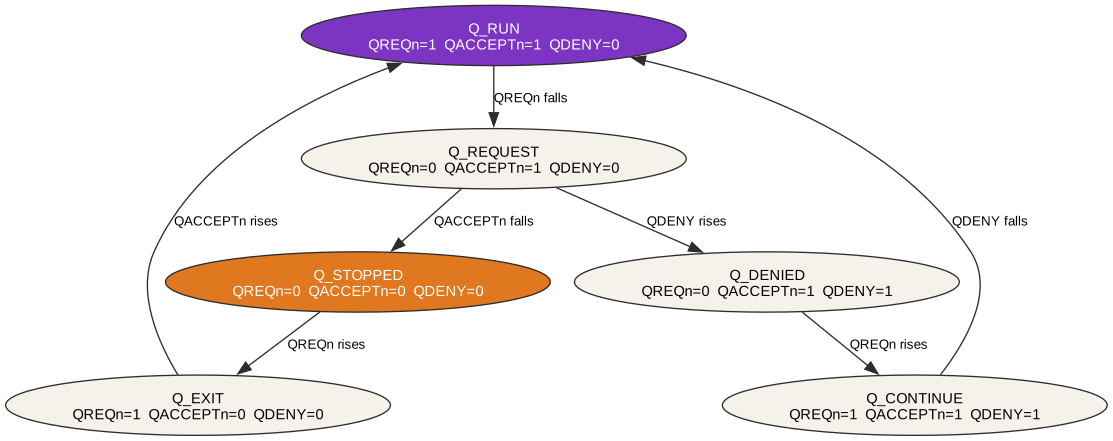
The state table lists every legal combination and the corresponding device status:
| State | QREQn |
QACCEPTn |
QDENY |
Device status |
|---|---|---|---|---|
| Q_RUN | 1 | 1 | 0 | Operational |
| Q_REQUEST | 0 | 1 | 0 | Draining activity; quiescence requested |
| Q_STOPPED | 0 | 0 | 0 | Quiescent; clock or power gating is safe |
| Q_EXIT | 1 | 0 | 0 | Restoring clock or power (implementation-defined delay) |
| Q_DENIED | 0 | 1 | 1 | Device denied the request; remains operational |
| Q_CONTINUE | 1 | 1 | 1 | Controller deasserted QREQn after denial |
The combination QACCEPTn=0, QDENY=1 is illegal and must never occur.
Accepted handshake
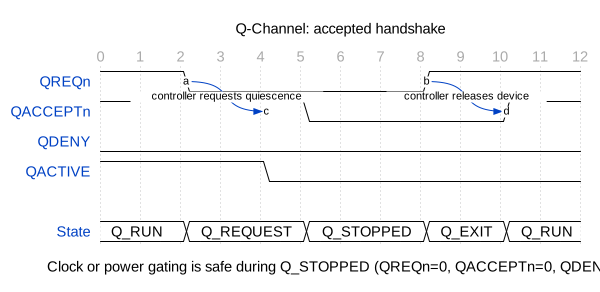
The accepted path runs from Q_RUN through Q_REQUEST, Q_STOPPED, and Q_EXIT and back to Q_RUN. The controller asserts QREQn low to start the handshake. The device drains its outstanding activity, drops QACTIVE, then asserts QACCEPTn low to confirm it is quiescent. The controller can gate the clock or power during Q_STOPPED. When the controller is ready to restore the device, it deasserts QREQn high, entering Q_EXIT. The device responds by deasserting QACCEPTn high once it detects the restored clock, returning to Q_RUN.
Denied handshake
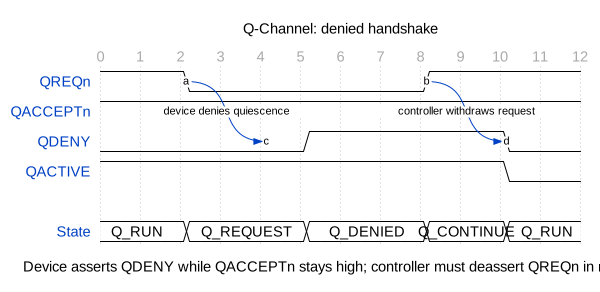
The denied path branches from Q_REQUEST when the device cannot quiesce. The device asserts QDENY high while keeping QACCEPTn high, entering Q_DENIED. The controller must withdraw its request by deasserting QREQn high, entering Q_CONTINUE. The device then deasserts QDENY low, and both sides return to Q_RUN. The controller can reattempt the request after it observes Q_RUN.
Handshake transition rules
The IHI0068 specification defines strict conditions for each signal transition. These rules prevent illegal states from being reached.
QREQn rules:
QREQncan fall only whenQACCEPTnis HIGH andQDENYis LOW (the interface is in Q_RUN).QREQncan rise when bothQACCEPTnandQDENYare LOW (Q_STOPPED), or both are HIGH (Q_CONTINUE).
QACCEPTn rules:
QACCEPTncan fall only whenQREQnis LOW andQDENYis LOW.QACCEPTncan rise only whenQREQnis HIGH andQDENYis LOW.
QDENY rules:
QDENYcan rise only whenQREQnis LOW andQACCEPTnis HIGH.QDENYcan fall only whenQREQnis HIGH andQACCEPTnis HIGH.
P-Channel: multi-state power transitions
P-Channel (Power Channel) handles power management for devices that support multiple distinct power states. Each state can have different voltages, clock frequencies, and retention configurations. Use P-Channel when Q-Channel's binary run-stop model is insufficient for the power architecture. P-Channel communicates the target state directly to the device through an implementation-defined PSTATE encoding, rather than an implicit quiesce signal.
P-Channel signals
P-Channel uses 5 signals. The controller drives PSTATE and PREQ; the device drives PACTIVE, PACCEPT, and PDENY.
| Signal | Direction | Active level | Width | Description | Introduced |
|---|---|---|---|---|---|
PACTIVE[N-1:0] |
Device to controller | HIGH | N bits | Device activity indication; one bit per domain | IHI0068 B |
PSTATE[M-1:0] |
Controller to device | -- | M bits | Target power state (implementation defined) | IHI0068 B |
PREQ |
Controller to device | HIGH | 1 bit | Power state transition request | IHI0068 B |
PACCEPT |
Device to controller | HIGH | 1 bit | Device accepts the requested transition | IHI0068 B |
PDENY |
Device to controller | HIGH | 1 bit | Device denies the requested transition | IHI0068 B |
PREQ and PSTATE must be register-driven at the controller. PACCEPT and PDENY must be register-driven at the device. The PSTATE encoding is implementation defined; ARM publishes recommended values in the Power Policy Unit Specification. Only one of PACCEPT or PDENY changes per handshake transition.
P-Channel state machine
The P-Channel defines 6 states, determined by the values of PREQ, PACCEPT, and PDENY. The normal path transitions from P_STABLE through P_REQUEST and P_ACCEPT before returning to P_STABLE. The denied path branches from P_REQUEST and returns via P_CONTINUE.
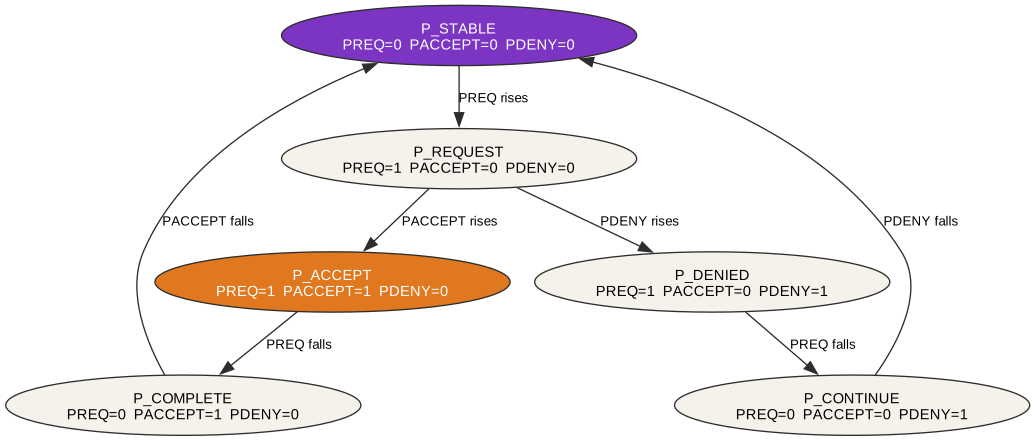
| State | PREQ |
PACCEPT |
PDENY |
Description |
|---|---|---|---|---|
| P_STABLE | 0 | 0 | 0 | Idle; device is in its current power state |
| P_REQUEST | 1 | 0 | 0 | Controller requests a transition to PSTATE |
| P_ACCEPT | 1 | 1 | 0 | Device accepts; transition is in progress |
| P_COMPLETE | 0 | 1 | 0 | Controller deasserts PREQ; transitional state |
| P_DENIED | 1 | 0 | 1 | Device denies the requested transition |
| P_CONTINUE | 0 | 0 | 1 | Controller returns PREQ low after denial; transitional state |
Accepted transition
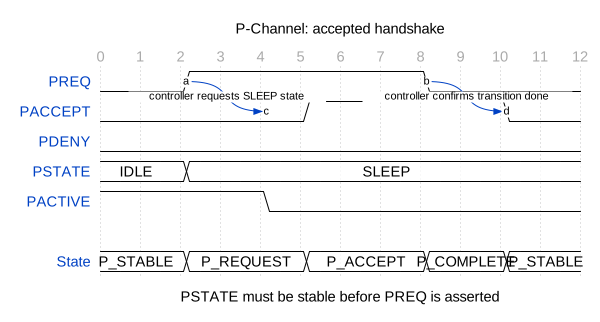
The controller sets PSTATE to the target state before asserting PREQ high. The device samples PSTATE when it detects PREQ rising. When the device is ready to transition, it asserts PACCEPT high. The controller responds by deasserting PREQ low, entering P_COMPLETE. When the transition completes, the device deasserts PACCEPT low and both sides return to P_STABLE.
Denied transition
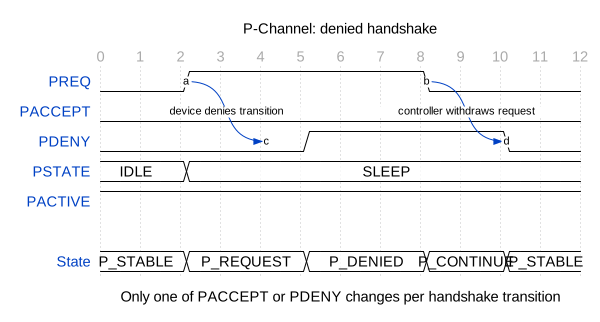
If the device cannot accept the requested transition, it asserts PDENY high instead of PACCEPT. The controller must respond by deasserting PREQ low, entering P_CONTINUE. The device then deasserts PDENY low, and both sides return to P_STABLE. The controller can reattempt the transition with the same or a different PSTATE value.
Choosing between Q-Channel and P-Channel
Q-Channel covers the majority of clock gating and simple power gating use cases. P-Channel is appropriate when a device supports multiple defined power states that require explicit enumeration. The ARM recommendation is to use Q-Channel where it is sufficient and to introduce P-Channel only for IP blocks with complex power policies.
| Criterion | Q-Channel | P-Channel |
|---|---|---|
| Number of power states | 2: run or quiescent | Many; implementation defined |
| Target state communicated to device | None; quiescence is implicit | Via PSTATE encoding |
| Backward compatible with AXI Low Power Interface (LPI) | Yes (without QDENY) |
No |
| Complexity | Low | Higher |
| Typical use | Clock gating, simple power gating | Retention states, multi-voltage domains, complex power policy |
Parity protection: Issue D additions
Issue D of IHI0068 (published September 2021) added optional parity protection to both Q-Channel and P-Channel. Each primary signal gains a companion check signal with a CHK suffix. For example, QREQn pairs with QREQCHK, and QACCEPTn pairs with QACCEPTCHK. Each check signal carries the odd parity of its primary signal, so the XOR of any signal and its check signal equals 1 when no fault is present. Parity protection is optional; systems without fault-detection requirements can omit the check signals.
Q-Channel parity signals
| Primary signal | Check signal | Direction |
|---|---|---|
QREQn |
QREQCHK |
Controller to device |
QACCEPTn |
QACCEPTCHK |
Device to controller |
QDENY |
QDENYCHK |
Device to controller |
QACTIVE |
QACTIVECHK |
Device to controller |
P-Channel parity signals
| Primary signal | Check signal | Direction |
|---|---|---|
PACTIVE[N-1:0] |
PACTIVECHK[N-1:0] |
Device to controller |
PSTATE[M-1:0] |
PSTATECHK[M-1:0] |
Controller to device |
PREQ |
PREQCHK |
Controller to device |
PACCEPT |
PACCEPTCHK |
Device to controller |
PDENY |
PDENYCHK |
Device to controller |
Backward compatibility with AXI LPI
AXI Low Power Interface (LPI) predates IHI0068 and uses three signals: CSYSREQ, CSYSACK, and CACTIVE. Q-Channel is the direct replacement and maps to these signals as follows:
| AXI LPI signal | Q-Channel equivalent | Notes |
|---|---|---|
CSYSREQ |
QREQn |
Controller drives both |
CSYSACK |
QACCEPTn |
Device drives both |
CACTIVE |
QACTIVE |
Device drives both |
| (none) | QDENY |
Tie QDENY LOW at the controller when connecting to an AXI LPI device |
When connecting a Q-Channel controller to an AXI LPI device that has no QDENY port, tie QDENY LOW at the controller. This removes the denied path and reduces the interface to the backward-compatible subset.
Summary
AMBA Low Power Interface (LPI) provides two complementary handshake protocols for coordinating safe clock and power gating on System on Chip (SoC) designs. Q-Channel handles run-stop quiescence with 4 signals and 6 states, making it well suited to clock gating and straightforward power gating. P-Channel handles multi-state power transitions where the controller communicates the target state directly using an implementation-defined PSTATE encoding. Both interfaces follow strict transition rules to prevent illegal states. Issue D of IHI0068 added optional parity check signals to both interfaces for functional safety applications. The full specification is available from the ARM Documentation Service as IHI0068D.