A product listing reads: full-flat grind, jimping on the spine, short ricasso, generous choil. Half of those words name nothing you can point at. Here we introduce the anatomy of a knife.
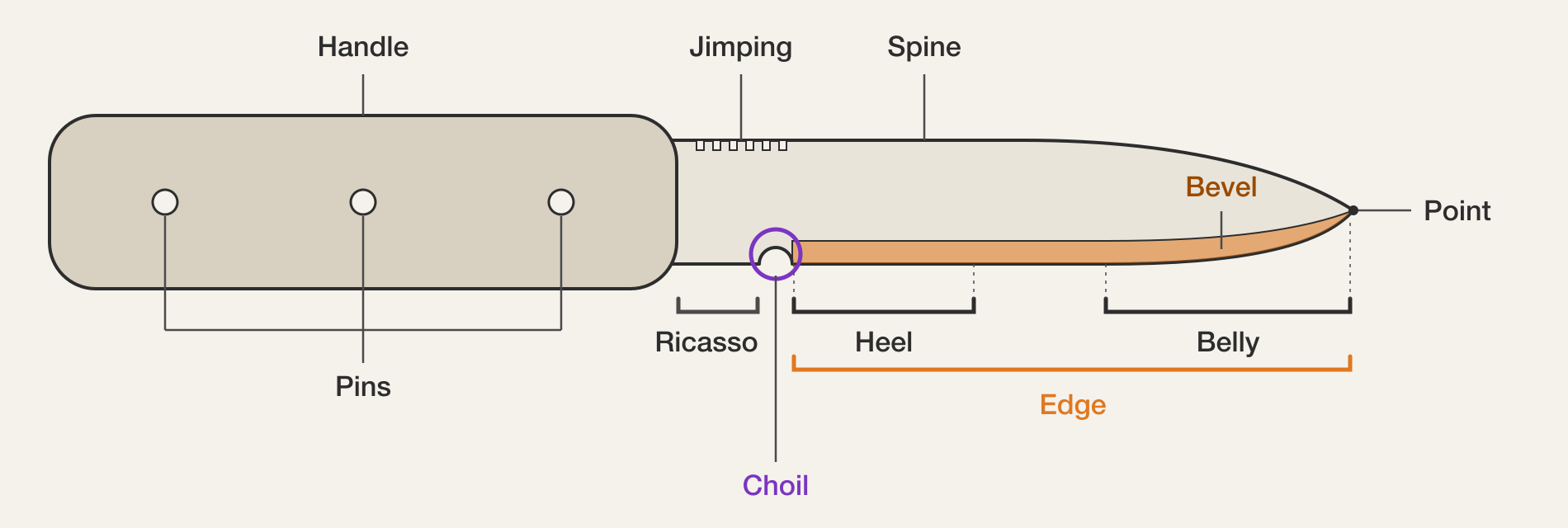
The edge, bevel, belly and heel
The edge is the line that cuts. The bevel is the ground face that leads up to it, and its cross-section is the grind described in Knife Grinds and Their Main Uses.
The belly is the curved part of the edge near the point. Slicing happens mostly on the belly, so a deeper curve slices food and rope more easily.
The heel is the rear section of the sharpened edge, nearest the handle. It sits directly in front of the grip, so the force of your hand goes straight into the cut. Use the heel for cuts that need force, and the belly and point for cuts that need finesse.
The spine and point
The spine is the unsharpened back of the blade. Your thumb or palm presses on it for control during careful cuts.
The point is where the spine and edge meet. Its position changes how the knife behaves, which Knife blade shapes covers.
The handle, tang and pins
The tang is the part of the blade steel that extends into the handle. On a full-tang knife it runs the whole length of the handle, and the pins pass through it to hold the handle scales in place.
A full tang is stronger than a partial one, so most bushcraft knives use it.
Optional features: jimping, ricasso and choil
Not every knife has these three. Classic bushcraft knives such as the Casström Lars Fält have no jimping and no choil, and only a small ricasso. It is a Scandinavian-ground, full-tang knife with brass pins and a plain spine.
Jimping is a row of small notches on the spine near the handle. It stops the thumb slipping.
The ricasso is the flat, unsharpened part of the blade between the sharpened edge and the handle. Many makers stamp their name there.
The choil is a small notch where the sharpened edge ends. On a knife with a guard or handle close to the edge, the choil gives a sharpening stone room to reach the whole heel. Without one, the stone stops short and the last few millimetres wear into a step that catches on cuts.
Reading a product listing
Check three things before you buy:
- The blade length, measured from the point to the handle, not the overall length.
- Whether the tang is full or partial.
- Whether jimping, a ricasso or a choil is present, and whether you need them.
For the steel behind the edge, see Knife Steels Explained.